
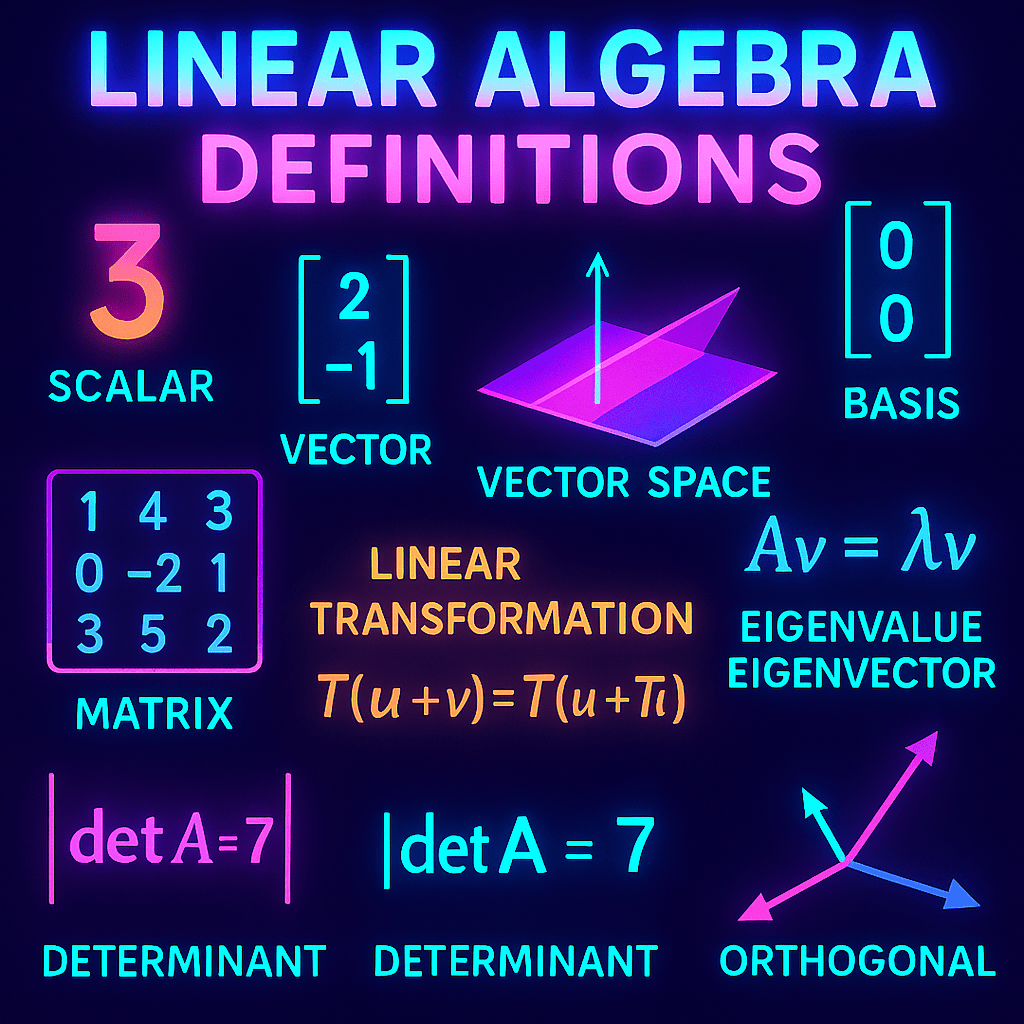
Basic Objects
- Scalar: A single numerical value, typically from a field like ℝ or ℂ.
- Vector: An ordered list of numbers (components) that can be added and scaled.
- Vector Space: A set of vectors with two operations (vector addition and scalar multiplication) satisfying 10 specific axioms (e.g., associativity, distributivity).
- Subspace: A subset of a vector space that is also a vector space under the same operations.
- Zero Vector: The unique vector in every vector space such that v + 0 = v for all vectors v.
- Linear Combination: An expression formed by multiplying vectors by scalars and adding the results.
- Span: The set of all linear combinations of a given set of vectors.
- Linear Independence: A set of vectors is linearly independent if no vector in the set can be written as a linear combination of the others.
- Basis: A linearly independent set of vectors that spans the entire space.
- Dimension: The number of vectors in any basis of the space.
Matrices and Matrix Operations
- Matrix: A rectangular array of numbers arranged in rows and columns.
- Square Matrix: A matrix with the same number of rows and columns.
- Row Vector: A 1×n matrix.
- Column Vector: An n×1 matrix.
- Matrix Addition: Combining matrices of the same size by adding corresponding entries.
- Scalar Multiplication (Matrix): Multiplying every entry of a matrix by the same scalar.
- Matrix Multiplication: Combining an m×n matrix with an n×p matrix to form an m×p matrix.
- Identity Matrix (Iₙ): A square matrix with 1s on the diagonal and 0s elsewhere. Acts as a multiplicative identity.
- Transpose (Aᵗ): Flips a matrix over its diagonal: row i becomes column i.
- Inverse Matrix (A⁻¹): A square matrix A is invertible if there exists a matrix A⁻¹ such that AA⁻¹ = I.
Linear Transformations
- Linear Transformation (or Linear Map): A function T: V → W that preserves vector addition and scalar multiplication:
T(u + v) = T(u) + T(v)
T(cu) = cT(u) - Kernel (Null Space): The set of all vectors v such that T(v) = 0.
- Image (Range): The set of all outputs T(v) for v in V.
- One-to-One (Injective): A map T is injective if different inputs map to different outputs.
- Onto (Surjective): A map T is surjective if every element of the codomain is hit by some input.
- Isomorphism: A linear transformation that is both one-to-one and onto (i.e., bijective).
- Matrix Representation of T: The matrix that implements a linear transformation with respect to specific bases.
Rank and Nullity
- Rank: The dimension of the image (column space) of a matrix.
- Nullity: The dimension of the kernel (null space) of a matrix.
- Rank–Nullity Theorem: For a matrix A with n columns: rank(A) + nullity(A) = n
Determinants
- Determinant: A scalar value associated with a square matrix that provides information about invertibility, volume scaling, and orientation.
- Cofactor: The signed minor of a matrix element, used in determinant expansion.
- Minor: The determinant of a smaller matrix formed by deleting one row and one column.
- Singular Matrix: A matrix with determinant zero; not invertible.
- Nonsingular Matrix: A matrix with a nonzero determinant; invertible.
Eigenvalues and Eigenvectors
- Eigenvector: A nonzero vector v such that Av = λv for some scalar λ.
- Eigenvalue: The scalar λ in the equation Av = λv.
- Eigenspace: The set of all eigenvectors corresponding to a particular eigenvalue, plus the zero vector.
- Characteristic Polynomial: The polynomial det(A − λI) used to find eigenvalues.
- Algebraic Multiplicity: The number of times an eigenvalue appears as a root of the characteristic polynomial.
- Geometric Multiplicity: The dimension of the eigenspace associated with an eigenvalue.
- Diagonalizable Matrix: A matrix A is diagonalizable if there exists an invertible matrix P such that P⁻¹AP is diagonal.
Orthogonality and Inner Product Spaces
- Inner Product: A generalization of the dot product: a function ⟨u, v⟩ satisfying positivity, symmetry, and linearity.
- Norm (‖v‖): The length of a vector:
‖v‖ = √⟨v, v⟩ - Orthogonal Vectors: Vectors u and v are orthogonal if ⟨u, v⟩ = 0.
- Orthonormal Set: A set of vectors that are both orthogonal and of unit length.
- Projection: The orthogonal projection of a vector onto a subspace.
- Gram–Schmidt Process: A method to convert a linearly independent set into an orthonormal set.
- Orthogonal Complement: The set of all vectors orthogonal to every vector in a given subspace.
Advanced Concepts
- Singular Value Decomposition (SVD): A factorization A = UΣVᵗ, where U and V are orthogonal and Σ is diagonal with nonnegative entries.
- Jordan Form: A block diagonal matrix similar to a square matrix over ℂ, used in generalized diagonalization.
- Minimal Polynomial: The smallest monic polynomial m(x) such that m(A) = 0 for a square matrix A.
- Cayley–Hamilton Theorem: Every square matrix satisfies its own characteristic polynomial.
- Spectral Theorem: A real symmetric matrix can be orthogonally diagonalized.

