
Introduction
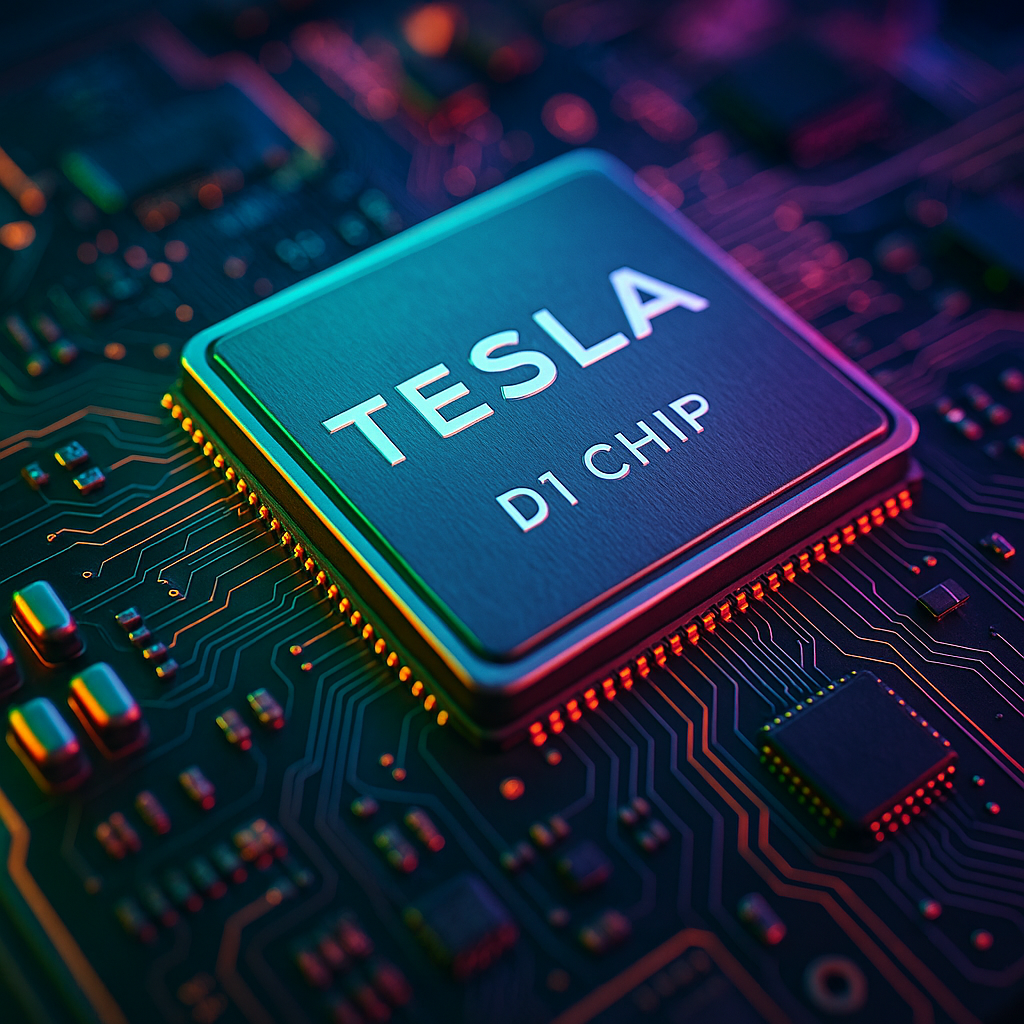
The Tesla D1 chip is a custom-designed, advanced semiconductor specifically developed by Tesla, Inc. as a core component of its artificial intelligence (AI) and high-performance computing initiatives. Announced during Tesla’s AI Day event on August 19, 2021, the D1 chip is tailored for machine learning tasks, specifically optimized for deep neural network training, AI model development, and advanced autonomous driving capabilities. It represents a significant step towards Tesla’s ambition of achieving high computational efficiency and independence from third-party suppliers in the rapidly evolving AI hardware industry.
Background and Development
Historically, Tesla has relied on established semiconductor manufacturers and commercial-off-the-shelf hardware to support its computational needs for vehicle autonomy and neural network training. Initially, the company utilized NVIDIA GPUs and processors for AI applications. However, given the increasing demands of large-scale neural network training, especially within the context of autonomous vehicle technologies and real-time inference workloads, Tesla identified significant benefits in developing proprietary hardware solutions.
The development of the D1 chip began as part of Tesla’s broader strategy to vertically integrate hardware and software ecosystems, reducing dependence on external suppliers, enhancing energy efficiency, and maximizing performance specifically for AI-driven automotive applications. Tesla’s efforts culminated in the creation of the D1 chip, designed internally by Tesla’s semiconductor engineers, under the oversight of the company’s Autopilot and AI teams led by industry veterans including CEO Elon Musk and senior engineering executives such as Pete Bannon and Ganesh Venkataramanan.
Technical Specifications and Architecture
The D1 chip is designed around Tesla’s proprietary microarchitecture optimized explicitly for neural network computation and machine learning algorithms. Its primary characteristics and technical specifications include:
Core Configuration
- Architecture: Custom-designed AI-centric architecture with an emphasis on parallelized computation.
- Fabrication Process: Built using TSMC’s advanced 7nm manufacturing process technology, enabling high-density transistor integration and superior energy efficiency.
Computational Power
- Compute Capacity: Each Tesla D1 chip provides approximately 362 TFLOPS (teraflops) of computing performance in BF16 (Brain Floating Point 16-bit) or FP16 operations, specialized numerical formats optimized for AI workloads.
- Matrix Multiplication Unit (MMU): Specialized units optimized for matrix multiplication and tensor operations, specifically targeting large-scale neural network training scenarios.
Core Count and Transistor Density
- Core Count: Each D1 chip consists of 354 training nodes or cores interconnected to achieve high parallelization and data throughput.
- Transistor Count: The D1 chip incorporates approximately 50 billion transistors, making it one of the most densely packed AI chips designed at the time of its announcement.
Interconnect Technology
- Chip-to-Chip Interconnect: Tesla introduced a high-speed, low-latency proprietary interconnect technology known as “Tesla Interconnect”, capable of providing terabits-per-second bandwidth between multiple D1 chips, enabling scalability into larger multi-chip modules and clusters.
- Bandwidth and Latency: Designed to support extremely low latency data transfers with extremely high bandwidth inter-chip communication, critical for maintaining efficient parallelism in neural network training.
Memory and Storage
- On-chip SRAM: The D1 chip integrates substantial on-chip Static Random Access Memory (SRAM) caches optimized for neural network workloads, enhancing memory access speed and reducing latency.
- External Memory: Utilizes advanced high-bandwidth memory interfaces, optimized for low-latency access and large-scale dataset handling.
Power and Efficiency
- Power Consumption: Tesla engineered the D1 chip specifically to maximize performance-per-watt efficiency, emphasizing the need to minimize power consumption while maximizing computational throughput.
- Energy Efficiency: Optimized architectures and transistor layouts provide substantial energy savings compared to traditional GPUs, allowing higher-performance density in large-scale clusters.
Applications and Deployment
Tesla’s Dojo System
The primary deployment of the D1 chip is in Tesla’s “Dojo” supercomputer, a powerful AI supercomputing system developed to accelerate neural network training, primarily to advance autonomous driving capabilities. The Dojo system leverages thousands of D1 chips interconnected through Tesla’s proprietary interconnect architecture, achieving unparalleled levels of parallelism and computational throughput.
The Dojo supercomputer cluster is specifically designed to:
- Accelerate neural network training cycles.
- Provide real-time inference capabilities.
- Support Tesla’s Full Self-Driving (FSD) and Autopilot development with rapid iteration on complex AI models.
- Handle petabytes of data from Tesla’s vehicle fleet.
Autonomous Driving Development
Tesla leverages the D1 chip as a foundational component for its ongoing advancements in autonomous driving software, particularly in improving Tesla’s Autopilot and Full Self-Driving (FSD) systems. By using proprietary hardware, Tesla is able to rapidly train neural networks on massive datasets gathered from millions of Tesla vehicles globally. The accelerated training directly translates into improvements in perception, decision-making, path-planning, and vehicle control.
Competitive Positioning and Market Impact
Tesla’s introduction of the D1 chip represents a strategic response to evolving competitive dynamics within the semiconductor and AI industries. By vertically integrating hardware design, Tesla aims to achieve several competitive advantages:
- Performance Optimization: Custom hardware provides significant performance advantages tailored precisely for Tesla’s AI workloads compared to off-the-shelf GPUs and general-purpose accelerators.
- Cost Reduction: Eliminating third-party dependencies, particularly from suppliers like NVIDIA, Intel, or AMD, reduces overall hardware costs in large-scale deployments.
- Technological Leadership: Demonstrating technological superiority through custom hardware innovations positions Tesla as a leader in AI and automotive industry innovation, potentially opening new revenue streams or partnerships.
Moreover, the deployment of the Dojo supercomputer utilizing the D1 chip further distinguishes Tesla from traditional automotive companies, reinforcing its identity as both an automotive manufacturer and a technology-centric enterprise.
Comparison with Competing AI Chips
Tesla’s D1 chip competes with high-performance AI accelerators developed by established semiconductor companies such as NVIDIA (e.g., A100 and H100 GPUs), Google (TPU – Tensor Processing Units), and AMD (MI250/MI300 accelerators).
Distinctive Advantages
- High Scalability: Tesla’s chip-to-chip interconnect enables seamless scaling from single-chip modules to massive supercomputing clusters.
- Performance-Per-Watt Optimization: Superior energy efficiency targeted specifically at automotive-grade AI workloads compared to general-purpose GPUs.
Challenges and Limitations
- Ecosystem Development: Adoption and development of supporting software ecosystems, including compilers, APIs, libraries, and developer tools, pose challenges relative to more established hardware platforms like NVIDIA’s CUDA ecosystem.
- Volume Production: Achieving economies of scale and yield consistency in large-scale chip manufacturing can present significant challenges, especially for companies newer to semiconductor design and manufacturing.
Future Outlook and Strategic Significance
The Tesla D1 chip represents a critical strategic component in Tesla’s long-term vision of developing advanced autonomous vehicles, AI-driven products, and supporting infrastructure. It lays the foundation for future iterations of increasingly powerful, scalable, and efficient chips.
Future developments may include:
- Continued iteration on chip designs and shrinking fabrication processes (potentially moving to 5nm or smaller nodes).
- Further refinement and scaling of the Dojo supercomputer system.
- Expansion of the D1 chip’s capabilities into broader AI applications beyond autonomous driving, potentially into robotics, energy grid optimization, and AI-driven manufacturing processes.
Conclusion
The Tesla D1 chip symbolizes Tesla’s ambitious integration of cutting-edge hardware and AI technology. Designed explicitly for deep neural network training and optimized for Tesla’s autonomous driving applications, the D1 chip showcases a significant technological advancement, positioning Tesla strategically within the rapidly evolving AI semiconductor market. As Tesla continues its pursuit of full vehicle autonomy and advanced AI applications, the D1 chip remains foundational in shaping the company’s technological future and reinforcing Tesla’s position as an industry innovator in AI and automotive technologies.

